


Pressure Washing, Chatham
Earlier in the year we received a text message from a potential customer requesting a quote to have their large block paved driveway cleaned.
We arranged a site visit as requested by the customer as rightfully, so they wanted to meet the company that they were potentially looking to contract to carry out this work as it was a large job, so the customer wanted to do their due diligence to ensure we were up to the task. As planned, we travelled out to the customer, measured the area and offered a quote. The customer was more than happy to go ahead with the work, and we booked them in right away.
We later returned on the planned date to carry out the work. Straight away we faced the challenge of low water pressure coming from the tap, this is a common issue we face in domestic properties but is something we know how to make the best use of. So, we got started with the cleaning, due to the buildup of stubborn white lichen we needed to adjust the nozzles on our flat surface cleaner and increase the pressure output from our machine using the unloader all in the effort of hitting the “white spot” with as much pressure as we could. Once an area received its first pass with the flat surface cleaner we then went back over with a turbo nozzle to rinse the surface debris towards a gathering point whilst cutting in the edges and spot cleaning areas the flat surface cleaner may have struggled with. We repeated this process until the entire drive was cleaned. We then went back over the entire surface with a treatment of Sodium Hypochlorite, “Hypo”, this is left to dwell for 15 minutes before being thoroughly rinsed away. This chemical is applied to kill surface algae and organics such as white and black where just pressure alone doesn’t always get them off entirely. With this through cleaning process we ensured the driveway was as clean as possible. Once we packed away our equipment we then went round and cleaned all the windows and sills along with rinsing all the surrounding areas to leave the entire property looking pristine. The customer was incredibly pleased with the results, shocked with how clean it came up given the fact it had been a very long time since they had it cleaned.
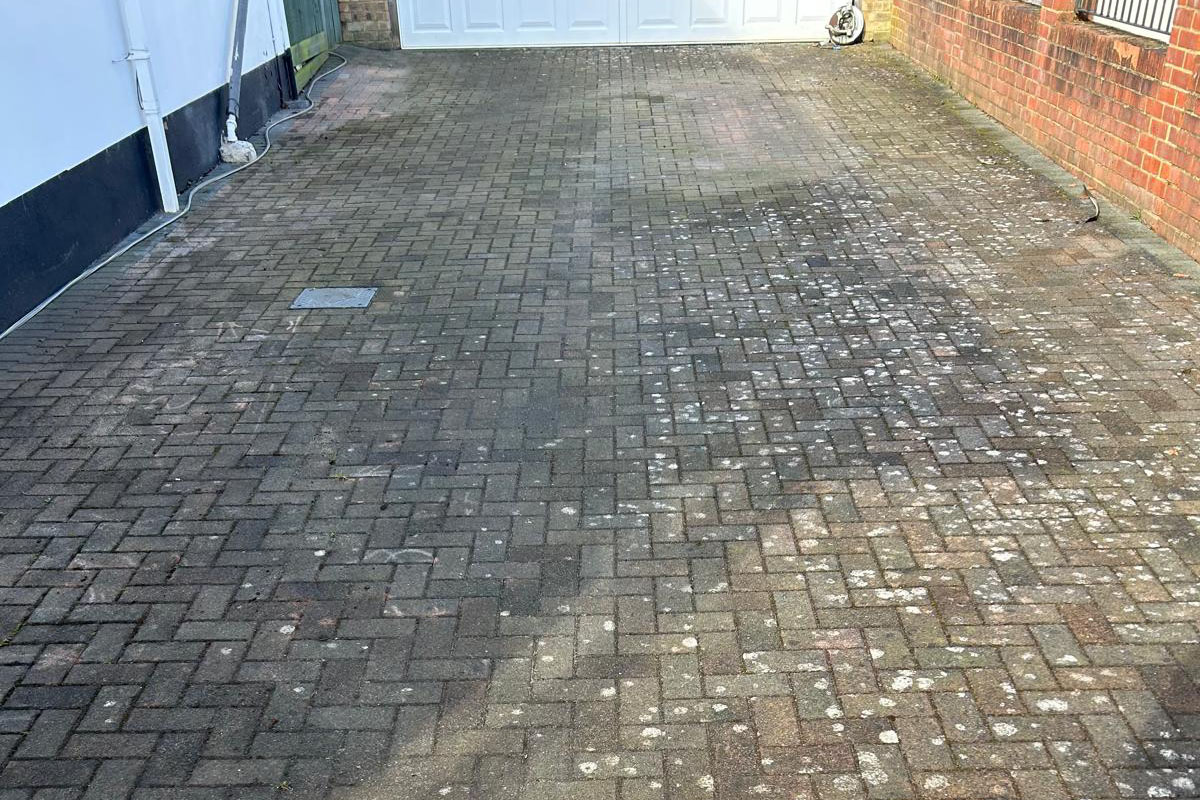
Before
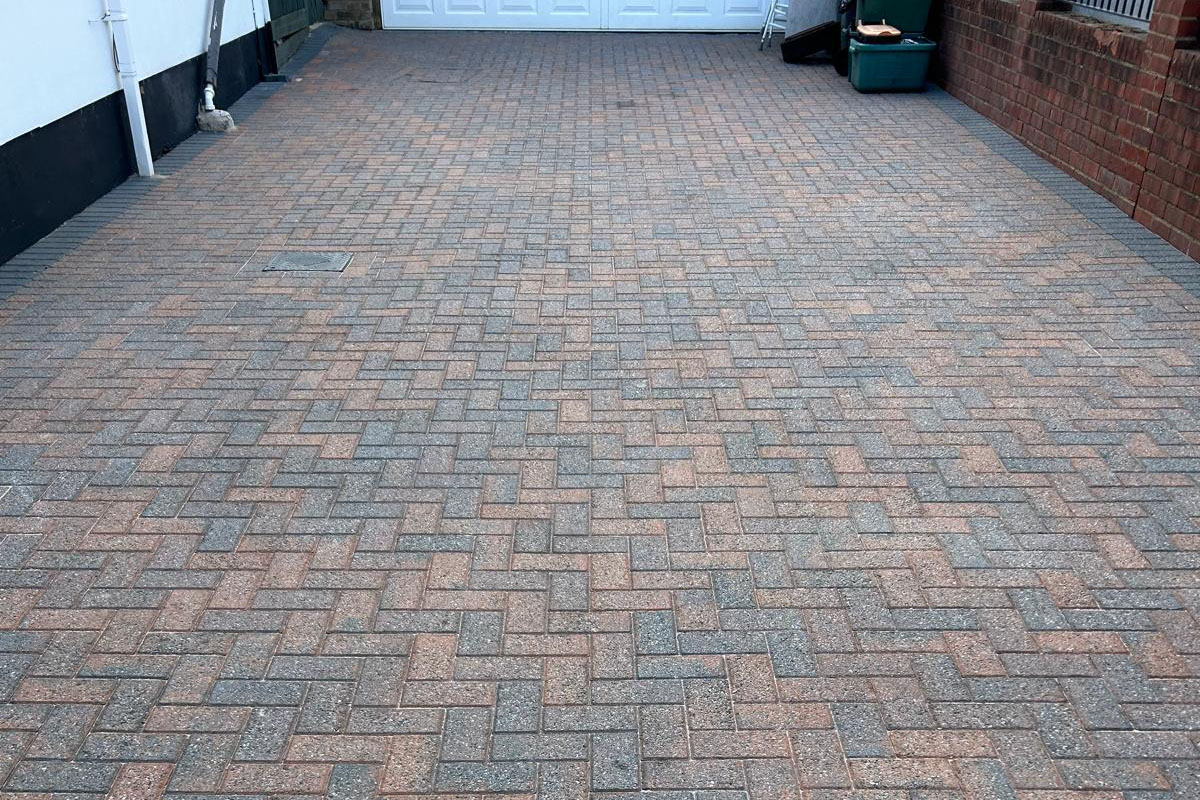
After
Lilypad Exterior Cleaning – Pressure Washing FAQs
It is very easy to damage a variety of surfaces with a pressure washer, even the DIY brands with lower PSI/BAR ratings. The likes of limestone, mortar, decking, concrete and various other surfaces can be “etched” when too much pressure is used on them or the incorrect nozzles are used. “Etching” will be visible from lines being left in the surfaces which unfortunately once there cannot be reversed as it is permanent physical damage. We use professional grade petrol powered pressure washers which have built in unloader valves, this valve allows us to accurately adjust the levels of pressure we are putting out so we can adjust accordingly to suit the surface we are cleaning. We also use a variety of nozzle tips for our lances once again to cater to each surface.
We will always assess whether a job needs chemical treatment before just applying it. A pass over the entire surface will firstly be done to remove surface dirt, grime and algae. Then we will visually assess the results as to whether chemicals are needed. For the majority of our jobs we will use a form of chemical treatment as more often than not we find either stains such as rust or oil stains hidden under the top layer of grime or in most cases the black spot (black lichen) simply has not budged from the high-pressured water alone. All our chemicals are licensed, HSE approved and label compliant and we store, transport, handle, dilute and apply these chemicals in the safest possible ways to ensure not only our staff are kept safe but the public are safe along with their properties and the local wildlife and watercourses.
We do require access to a water supply when cleaning a property. This can be from an outside tap, a hose ran into the house to connect to an indoor tap or even connect to a washing machine cold water feed. In cases where we cannot access water we can organise the rental of an water standpipe from the local authority. However we do not require an electrical supply as our pressure washers are all petrol powered.
We receive a lot of enquiries regarding stubborn black spot that customers have tried to remove themselves in the past but simply cannot get them to shift. Unfortunately, black spot is a form of lichen, and it grows into the stone below the surface, some surfaces suffer with it more than others such as sandstone which is very porous along with concrete and various other surfaces. Chemicals are a MUST to remove black spot, occasionally steam cleaning is an option especially if the use of chemicals is restricted, i.e. if the job is next to a water way. However, even with steam a lot of black spots can stay in the surface which is why chemicals are the best answer where they can be used, unfortunately these chemicals are controlled substances and restricted to sale only to professional service providers.
The quick answer is no; pressure washing will not kill the weeds growing in your driveway or patio. A pressure washer will certainly take the heads of the weeds off and most of the body, however, it’s not possible to reach the roots which is how the weed grows. The chemicals used during a clean will certainly damage the weeds roots often killing them and certainly prolongs the regrowth. The best answer for weeds is to apply a weedkiller two weeks before the ground is planned to be cleaned, this will allow time for the weedkiller to kill the weeds down to their roots. Once the surface has been cleaned keep a strict routine maintenance dose of weed killer once you see the weeds have started to regrow. Unfortunately, there is no true answer to prevent weed regrowth, instead they can be managed to keep them under control.
So now you’ve got a nice clean driveway or patio you want to keep it clean for as long as possible. Using a sealer can definitely be a good option, they act as a hydrophobic surface which causes the water to bead and repel from the surface. The idea behind a sealer is to help keep the water flowing off a surface where there is pitch so the water doesn’t just sit causing green growth. However our opinion on the fact is sealers are not worth it. The good brand of sealers are very expensive to buy and then if not doing it yourself you will be paying someone labour on top of the material costs to apply the sealer. If not done correctly they can go wrong and trap moisture under the sealer resulting in a cloudy look. Along with this each time you get the surface cleaned for best results you will need to use a chemical stripping agent such as Xylene to strip the sealer from the surface which is not only yet another cost but also a fairly harmful chemical to use. Also if the surface that is being sealed does not have a good pitch to it even with a sealer water will still sit on the surface resulting in green growth, not on your patio or driveway but rather on top of the sealer.
In conclusion, sealers are a good idea for selective reasons and scenarios. If you have a steep pitched driveway then yes, they can be worth considering as they will repel the water down the drive along with this the sealer will help keep the sand between your block paved driveway from being washed out. Other than that, the only other situation that sealers are a good idea would be on the area of a patio where a BBQ will be used regularly as the sealer will be a good defense against grease and fat spitting from the BBQ which can be tedious to get out of certain porous surfaces such as sandstone.
Yes you can pressure wash your decking however there is almost an “art” to do it correctly without damaging the wood. Using too much pressure, the incorrect nozzle tip or being too close to the wood will fur up the wood, split the edges and cause “tram lines” in the surface. To properly clean decking the correct pressure and nozzles must be used followed my chemical treatments to soak into the wood to kill the green growth that is deep in the wood. Unfortunately these chemicals are once again controlled substances and restricted and sold only to professional service providers.
As a homeowner, no, you cannot use your pressure washer, that’s to clean your driveway, patio or even your car. However, as a business we are exempt and allowed to use the water as we require it to carry out our business day to day.
After cleaning your block paved driveway or patio yes you need to resand it. Using kiln dried sand on a dry day and the surface must be bone dry you can simply sweep the sand into the joints. The reason for this is a portion of the existing sand will be washed out during the clean. The purpose for this sand it to fill any gaps and voids between the blocks which in turn stabilizes the block and prevents them from moving in place which in long term would start causing an uneven surface in the blocks.
We are asked this question a lot, the answer is no, if the grout is solid and healthy there will be no loss of grout. However, if the grout is compromised from age and weathering showing cracks and pulling away from the edge of the slabs then it is likely to come out. The other factor to keep in mind is the material type of the grout being used especially in newer patios, it is very common these days for landscapers to use cheaper quality brush in products, they will use these for the ease and speed of use. These products often claim to set as hard as cement when in reality they are often fragile and weak and even whilst using appropriate reduced levels of pressure these weak products are susceptible to coming loose. This also goes for if a weak sand and cement mix or a very dry mix is used. If the grout is a good quality epoxy bound resin or a strong sand and cement mix, then even with higher levels of pressure the grout will remain intact.