


Pond Maintenance
Helping To Keep Your Pond Healthy!
With almost a decade of working in the aquatic industry we have the knowledge and expertise to offer an extensive range of services for all your pond needs. Although scenic, relaxing and enjoyable it is no secret that ponds can be troublesome, a lot of work and with an endless range of products on the market ensuring each buy is the right one for your pond can be a minefield.

We are here to help to keep your pond healthy and wet pets happy!
Full Pond Clean-outs
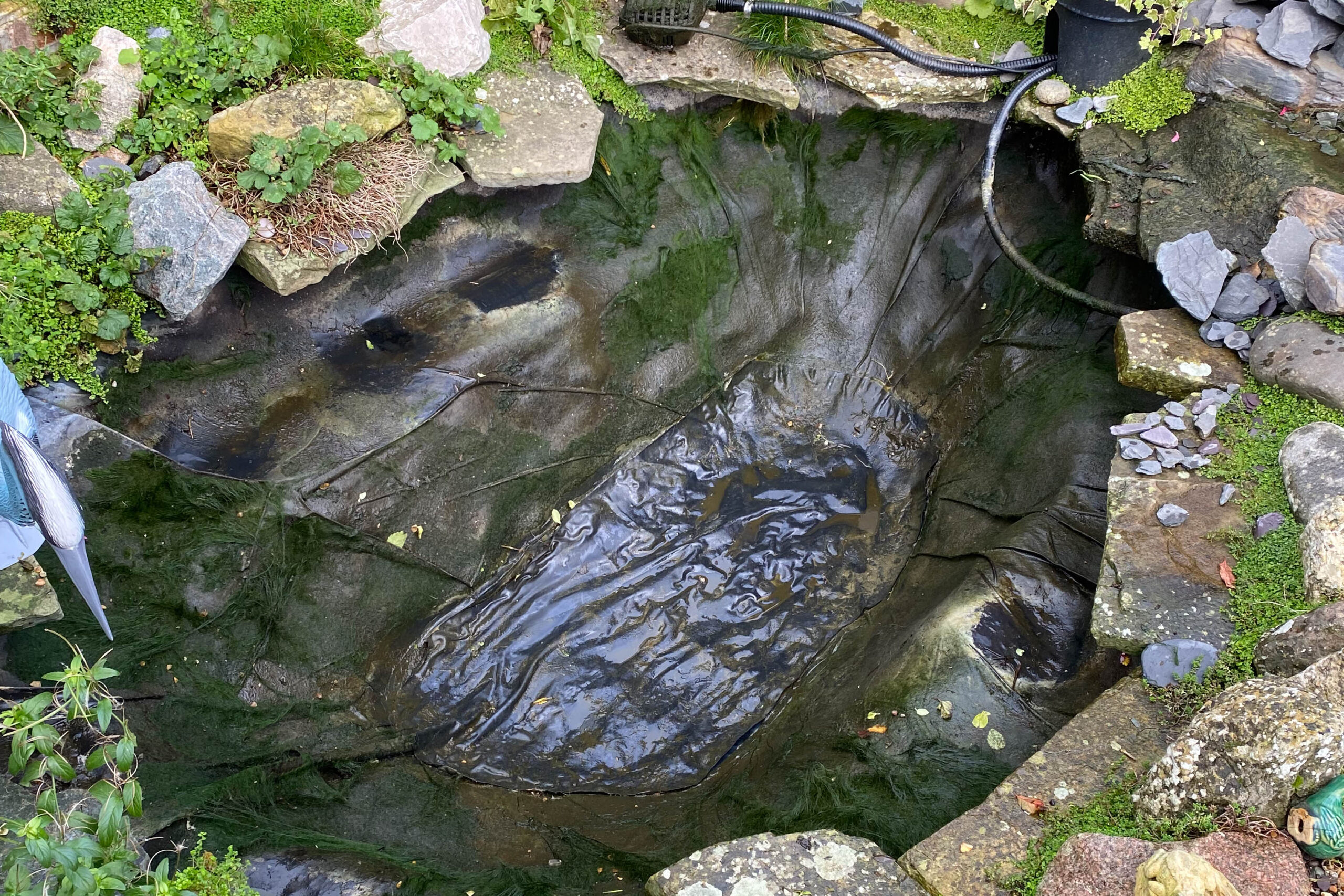
Our most popular service is a full pond clean out. This is a popular service as our initial pond of contact with a new customer and project. It allows us to get the pond back to a standard that can then be more easily maintained and kept ticking over and looking good all year round. A full clean out is exactly as it sounds; we net all resident fish to a temporary holding pen on site whilst we drain the pond of water. This then allows us to remove all the sludge, silt, plant matter and organics out of the bottom of the ponds. Followed by a thorough rinsing of the liner and then another final hoover out. Then being refilled with fresh water, treated with tap water conditioning chemicals to ensure the safety of the fish and lastly moving the fish back into their now fresh clean pond. During the cleaning process any and all pumps and filters will be serviced and cleaned along with pond plants dead headed and trimmed where required.
Regular Maintenance Visits
A full pond clean out is best accompanied by ongoing regularly planned visits throughout the year to keep the pond to a high standard. This can be from a monthly visit to a biannual visit and everywhere in between. During these visits pumps and filters will be serviced and maintained, plants will be trimmed and dead headed where required throughout the seasons and light hoovering of the pond will be done to help keep organics, silt and sludge from building at the bottom of the pond. Generally with a good maintenance plan put in place the need for further full pond clean out may not be needed again.
Equipment Installs & Servicing
Truly putting our decade in the aquatic industry to use we have an extensive knowledge on pond products and equipment allowing us to not only advise on new filters, pumps, treatments and much more but also the ability to install and maintain them. Whether it’s a new pump, filter system upgrade & alterations, pond lights & water fountains to add character to a pond and almost anything else we are here to help.
Reline & Repairs
If you are unfortunate enough to find yourself with a pond losing water we can investigate what can be the cause whether that’s a leaking filter gasket, split pipework or worse a hole in the liner we will do our best to get it water tight again. We can replace or repair leaking or split pipework and have a huge range of spares in the van at anytime to replace failed orings and gaskets. We can also reline a pond when required if a leak is determined to be in the pond itself and the hole cannot be found. With a choice of PVC or EPDM rubber liners to help cater to all budgets we will get your pond refreshed and water tight once again.
Lilypad Exterior Cleaning – Pond Maintenance FAQs
You can have your pond cleaned out at any time of the year, really the only difference is we get cold and wet in the winter compared to the summer! The one thing to be mindful of is if your pond is home to wildlife. Frogs and Toads will spawn between January and March and Newts will spawn between March and June. So, with this if you have a population of these it may be worth getting your pond cleaned out before these months or a couple of months later to avoid disrupting them. Although being said it is easy to move spawn into holding tubs during cleaning so if you want the pond cleaned during these times it can still be done.
Our routine maintenance typically includes:
- Water quality check
- Filter cleaning
- Light hoovering to remove sludge and debris
- Plant trimming and health check
- Pump inspection & cleaning
- Top-up and treatment (if required)
In most cases the pond we will be cleaning actively has Fish living in it. We will set up a temporary holding pool which we then transport the Fish into with some of their existing water whilst also letting the pool top up with some fresh water which we treat with a tap water conditioner. At the end of the day once the pond has been cleaned we will pump the water from the holding pool back into the pond and net the Fish back in. From the Fish’s point of view it was simply a brief holiday!
Absolutely, one of our most common requests is exactly this. We are often called out to bring existing ponds back to life where perhaps the care giver of the pond has moved house or sadly passed away leaving the family with a pond they have not had time to attend too or are unsure what to do with it. We handle full pond cleans and restorations, bringing even the greenest or most overgrown ponds back to life.
This is a difficult question to answer, the phrase “how long is a piece of string” comes to mind as there are a number of factors that come into play regarding the length of time it will take to clean a pond. Typically we have completed well over 90% of full pond clean outs within a single day but occasionally we will have to allow extra time and days if the pond is overly large or complex. The longest a pond has taken us to clean was across 4 days, this was due to the shear size and volume of water the pond held, the mass of debris that had accumulated at the bottom from the over hanging trees and the fact the pond was completely flat bottomed meaning there was not a deep spot where the water and debris wanted to naturally pool into so hoovering and rinsing was tricky but we got there in the end.
Not always, as long as we have access to the pond and related utilities required such as a water source and ideally a power supply, we can carry out the work and send you before/after photos.
No. We use eco-friendly methods, protect plants where possible, and ensure safe handling of wildlife such as frogs and newts.
Green water is usually caused by algae.
The clarity of your pond water can be affected by several factors. Firstly, if the water is green then immediately the first thought should be is my UVC clarifier working? Perhaps the lamp needs changing which is recommended to be done annually, or another consideration is if your UVC clarifier is big enough for your pond and if so an upgrade or additional UVC clarifier may be the answer. If you do not have a UVC clarifier then getting one installed is the best solution to this problem. There are also several “green water” treatments available on the market in shops however long term a UVC clarifier is truly the best solution. Another thought is whether the water parameters are at healthy levels. If left unchecked nitrates and phosphates in the water will steadily increase which in themselves directly feed the like of algae so a simple series of water changes to bring these back down to acceptable levels can help bring the water clarity back.
Now if your pond is murky with silt suspended in the water column then the initial first thought would be the base of the pond has buildup of silt, sludge and debris so therefore does the pond need vacuuming or even does it need a full clean out. The other thing to consider is your filtration system. Does it need some attention in the form of cleaning out, changing the sponges etc. Or is it not large enough for the pond, perhaps the baby Koi you purchased last summer have now grown so much that the volume of waste they produce now compared to their smaller, younger selves are simply too much of a strain on the original filter system. Once again there are “sludge buster” and “silt remover” chemicals readily available on the market in shops but this would really be a plaster on a bullet wound and instead dealing with the route problem will bring the best and longer lasting results.
Yes. We can supply and install any pond equipment including pumps, filters, air pumps, UV clarifiers and anything else. And with this we can advise on the best system for your pond.
Lilypad Exterior Cleaning covers all major parts of Kent, Including:
West Kent
- Maidstone
- Tonbridge & Tonbridge Wells
- Sevenoaks
- Paddock Wood
- Coxheath
- Staplehurst
- Headcorn
East Kent
- Canterbury
- Herne Bay
- Whitstable
- Margate
- Ramsgate
- Broadstairs
- Faversham
North Kent
- Medway Towns – Rochester, Chatham, Gillingham
- Sittingbourne
- Sheerness / Isle of Sheppey
- Gravesend
- Dartford
The answer depends on the details of the pond. If you have a wildlife pond with no Fish, then the answer is no you do not NEED a filter system for the welfare of the Fish however it is something to consider for the point of view for water clarity as the water has a high chance of going green during the summer months.
If you do have Fish in the pond, whether that’s Goldfish, Koi, Sturgeon or any other Fish then yes you NEED a filter system. The reason for this is simple, without a working filter the organics in the pond; the Fish waste, left over food, sludge and silt, will break down into ammonia. This is a toxic parameter to Fish and builds in concentration the longer the organics break down. A filter acts as a breeding ground for beneficial bacteria to grow which breaks down this ammonia into less harmful chemicals which are later diluted through rainfall, top ups and water changes. Without an adequate filtration system your pond water will become murky and green, the water parameters will become increasingly toxic and ultimately will end in loss of Fish.
Yes, you can use tap water in your pond, however the important thing to remember is to dose the new added water with an appropriate volume of water dechlorinator. This chemical is readily available from pond shops often labelled as “tap water treatment”, this chemical will detoxify chlorine, chloramine and heavy metals which all are harmful to aquatic life after long exposure. A question often asked is can I use rainwater? The problem with rainwater is it is too soft; it lacks any substantial volume of minerals which are essential for bodily functions in Fish. Long term use of rainwater often leads to a crash in parameters of the pond leading to mass fish loss. Whereas tap water, especially in the southeast of England, the water is very high with a high volume of minerals perfect for long term sustainability in fish health.
This is a very debated subject amongst the hobby and trade as people have their own opinions however a good rule of thumb is as follows; Goldfish growing to a potential adult size of 30cm they require an absolute minimum of 300 litres. This is again a bare minimum where a few Goldfish can live a long-term life of good health with a suitable volume of water to live in. Taking into consideration they will readily breed once they reach sexual maturity it is certainly worth allowing extra space for this so having a pond larger than 300 litres will give the Goldfish room to grow in numbers as they breed.
As for Koi these require a far larger pond, their potential adult size of 120cm makes them a potentially enormous Fish. A Koi typically attains an adult size of 60cm in a pond with some specimens reaching the 100cm+ size. Their adult size does depend on several factors: genetics, pond size, feeding both quality of food and frequency of feeding and finally water quality and parameters. An absolute bare minimum 4000-5000 litres and ideally aiming for a pond with a depth of a metre deep. The deeper portion of the pond will hold temperatures better if dug into the ground also with this koi really appreciate the third dimension of being able to swim up and down instead of just side to side. In shallow Koi ponds it’s not uncommon to see individuals with “fat necks”, often where they cannot burn off excess fat from swimming up and down.
Blanketweed often feels like a never-ending battle for pond keepers. It is unsightly and if left to go out of control can be harmful to pond inhabitants with Frogs becoming tangled when going up for breath or Sturgeons getting caught up often leading to death. Unfortunately, blanketweed seems to come and go as it pleases and can be a long-term fight to get rid of. However, going back to basics, blanketweed is simply a plant and a plant needs two things to grow; nutrients which is good supply in a pond from Fish waste and other organic matter and secondly light which the Sun gives a lot of. In a perfect ideal world if you can reduce the number of hours your pond receives sunlight; in the form of a pergola, cover etc. would massively help against the growth of blanketweed. But for more practical solutions testing the water for parameters such as nitrates and phosphates will give you a good idea of where to go with the problem. If these levels are too high, it’s essentially an open tap of nutrients feeding the blanketweed. So, a suggestion would be to firstly carry out a series of water changes to reduce the levels, secondly you can look at the market of pond products that help in reducing these parameters such as phosphate/nitrate removing blocks, chemicals and granules. You can also purchase a blanketweed control treatment from a pond shop that comes in the form of a white powder which you mix with some pond water and dose across the pond, often requiring numerous ongoing doses but usually see good results.
Another option but should only be considered for the larger ponds would be Grass Carp. This is a species of Carp that attains a large maximum adult size of 120cm so before jumping to this option consider whether you have a pond large enough for this Fish and if you want to house one long term as it’s a long-lived specie. If your pond would make a good home for a Grass Carp then these are a fantastic option to control your blanketweed as they have a known taste for it, be warned though blanketweed would not be the only thing on the menu for these gentle giants, anything green and leafy will be lunch including your beautiful pond Lily!
There is no simple answer to his question as it does depend on what Fish you have, how big are they, how many Fish you have and what time of year it is. Fish are cold-blooded, so their metabolism is affected by the temperature of the water. The warmer the water the faster their metabolism is and the more they want to eat, the colder the water the less they will want to eat and in the coldest times of the year when water is low single digits or lower Fish will often cease eating altogether. But a simple rule to follow is to pop a small amount of food in, watch them feed, if they eat all the food then put some more in. Repeat this until they no longer show interest, any food left uneaten after a few minutes should be netted out otherwise it will decay in the pond and in large quantities can cause ammonia spikes.
A healthy, happy Fish should be seen swimming calmly through the water upright with all their fins spread out. A common problem pond keepers meet is their Fish at the surface “gasping” for air. This is a sign of the Fish struggling with breathing. Unlike other Animals, Fish do not possess lungs instead they rely on gills for respiration/breathing. Usually, the simple act of them breathing is not very noticeable however when they are struggling them will expand their gill plates in and out and open and close their mouth almost reflecting that of “gasping”. The cause for this can be several things, firstly a lack of oxygen in the water column. If the water surface is not agitated enough the vital gas exchange of CO2 exiting the pond and oxygen entering can be affected causing a low level of oxygen. A simple fix to this is to cause surface agitation in the form of an air pump, fountain, waterfall etc. Another cause of the “gasping” can be nitrite poisoning; this is easily tested for with a simple pond water test kit. If nitrite is present this will heavily affect the Fish’s ability to absorb oxygen through their gills. A quick fix would be to carry out a series of partial water changes to bring the nitrite levels down, also adding beneficial bacteria products to your filter can aid in breaking down the nitrites. Ultimately investigating why nitrite is present in the first place is vital to avoid a recurrence.
Another cause of “gasping” can be a symptom of underlying parasite such as Gill Flukes which in severe cases can be such a strong infestation that it physically affects the gill’s ability to absorb oxygen.
This is a very common question asked by pond keepers in the UK where temperatures can reach subzero and consistently stay at low single digits for long periods of time. Firstly, with Fish being cold blooded animals their metabolism is affected by temperature so the colder it is the less they will want to feed, with exception to Sturgeon and Sterlets who will continue to feed throughout the winter periods. During the colder periods a reduction in feeding is expected often feeding only once a week and even a complete halt of feeding in the coldest temperatures.
The next thing to think about is filtration systems, although these are vital for the rest of the year to keep the water parameters in check during the colder periods of the year where water can freeze it is worth turning all pumps off. The reason for this is even running water will freeze at 0c so the last thing you want is water to freeze in your pipes and hoses which then results in excessive pressure pushing outwards causing the pipes and hoses to split ultimately leading to leaks when the water is once again running.
The last thing to consider is the oxygen levels for the Fish. If the temperature drops to 0c the water in your pond can freeze, in the deeper parts of the pond especially if dug into the ground the water is unlikely to freeze. However the surface layer will very likely freeze and if it does the vital gas exchange of oxygen entering the pond and Co2 exiting will be affected. An old school fix to this is to leave a couple of tennis balls floating in the pond so when the water does freeze you can pop the balls out leaving behind air holes. You can also break the ice but be careful as large heavy chunks of ice falling in the pond can damage the liner/walls of the pond and not to mention may hit the Fish. These days you can also purchase pond ice vents and pond heaters, these aim to produce a small area of heat that will keep the water in its immediate vicinity to not freeze.
Not only do pond keepers have to keep their Fish alive through care water quality monitoring, a healthy diet, adequate filtration etc. they must also be mindful of native predators, most commonly Herons and Seagulls. Herons are known for completely clearing ponds of Fish, even Koi are susceptible to predation. There are several deterrent-based products available on the market; shiny balls with eyes painted on them, Heron statues, laser and alarm systems and many more. Unfortunately, Herons are smart animals and come to learn that these products are not a threat to them and will often overlook them. Ultimately the best solution is a physical barrier whether than is a wire fence around the perimeter of the pond, netting across the pond or even electric fencing around the pond. A physical barrier will create a fool proof way of stopping the Herons from wading into the pond to collect their lunch.
Seagulls on the other hand although not known for clearing ponds will give it good go trying to peck at the Fish very rarely resulting in a takeaway meal for them but leaving your Fish with open wounds often leading to infection such as ulceration if left unsupervised or treated. The same goes for Seagulls as it does for Herons, a physical barrier is your best choice however in this case Seagulls approach the water from above so any wire fencing will not work, netting or a cover over the pond is a must.
To answer simply, YES you can top up your pond even during a hose pipe ban. Fish are covered under the Animal Welfare Act 2006, one of the five needs stated in that law is “To be housed in a suitable environment” this covers a pond being adequately filled and the water quality at appropriate parameters and if this is not the case then a water change is needed or the pond to be topped up. This also allows a full pond clean out to be taken place whether that is by the homeowner or a professional service provider.